The region continues to oscillate between signs of military escalation and the possibility of a political settlement, amid ongoing US and Israeli military preparations alongside mediation efforts aimed at ending the war.
As the crisis between the United States and Iran remains deadlocked, Israel and the United States are considering launching a new military strike against Iran in the near future, according to sources familiar with the discussions cited by CBS News on Sunday. This suggests that an attack could take place before the start of the new year, contrary to US President Donald Trump’s recent announcement that he would wait until January 2027 before making a decision on Iran.
Although Iran’s accelerating efforts to rebuild its military capabilities are among the main reasons behind consideration of another strike, other factors could make military action more urgent. Chief among them is the strain on US forces caused by the prolonged deployment of a large military presence in the region.
The US Central Command (CENTCOM) recently warned that maintaining the military deployment beyond December would increase pressure on financial and military resources and could affect the combat readiness of US forces, following nearly ten months of continuous presence in the region.
These pressures coincide with a funding crisis at the US Department of Defense (Pentagon), which is expected to reach a resolution by December 11, amid disagreements over renewing its funding. Political challenges are also looming with the start of a new congressional session in January, as the new political balance could complicate efforts to pass a resolution authorizing military action and potentially limit the president’s room for maneuver on this issue.
Taken together, these factors place the US administration before a complicated timeline. Delaying the military option until next year could become more costly operationally and politically if the military deployment and pressure on resources continue.
Meanwhile, US President Donald Trump continued to speak about the possibility of reaching an agreement with Iran in remarks to Fox News. However, he reiterated that he would not allow Tehran to acquire a nuclear weapon, keeping the military option on the table alongside diplomatic efforts.
The Hebrew-language newspaper Israel Hayom reported that the military option remains firmly under consideration in Washington. Israeli media outlets have also pointed to growing coordination between the two allies, despite the continuation of diplomatic contacts with Tehran.
Israel's Channel 13 reported that the Israeli military and US Central Command (CENTCOM) had approved joint military plans in preparation for a possible resumption of hostilities with Iran. The channel quoted an Israeli officer as saying that Tel Aviv was awaiting Trump's decision on the next step toward Tehran, at a time when pressure to resume the war is mounting.
The report followed a visit to Israel by CENTCOM Commander Brad Cooper, who met with Israeli Chief of Staff Eyal Zamir and Mossad Director Roman Gofman in Tel Aviv on Wednesday. The Israeli military said the commanders reviewed regional developments and shared security challenges, and discussed strengthening strategic and operational cooperation, intensifying coordination, and raising readiness levels for various potential scenarios.
The military did not specify the nature of the scenarios discussed. However, these meetings, together with reports of heightened military preparedness, reinforced indications that Washington and Tel Aviv are continuing to consider the possibility of launching new strikes, even as diplomatic efforts persist.
In a related development, the Financial Times reported that CENTCOM had warned the Trump administration that maintaining the military buildup in the region beyond December could place additional pressure on military resources and the combat readiness of US forces.
The difficulties facing the diplomatic track have once again drawn attention to the potential scope of US military operations. Axios, citing US officials, reported that Washington had prepared a new list of potential targets inside Iran, with sites at the heart of the country's nuclear program topping the list.
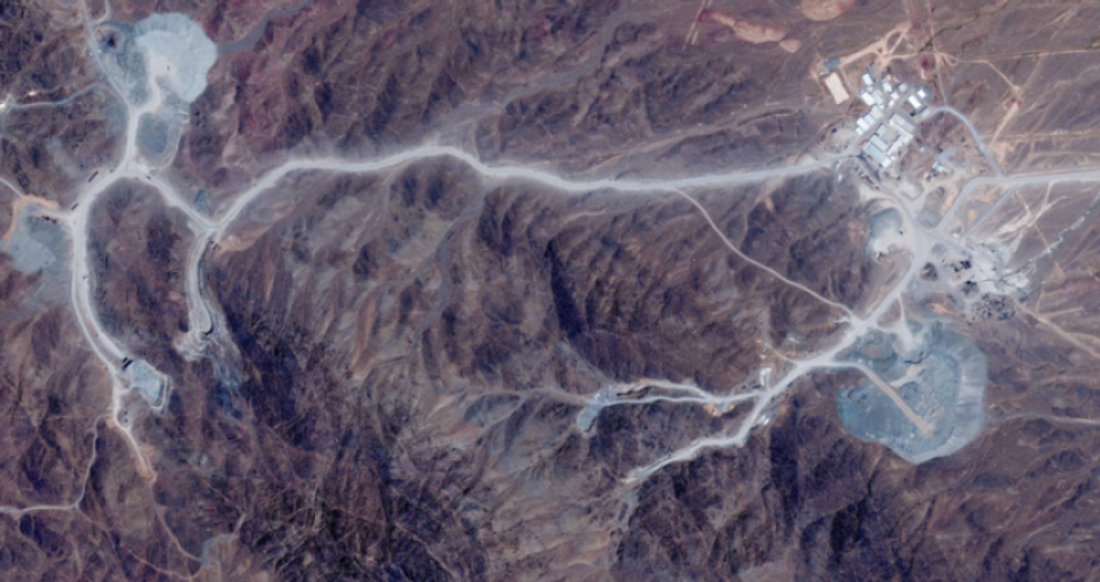
According to the report, the list includes Mount Pickaxe, where strikes could damage Iran's nuclear program or set it back by several years. It also includes the known enrichment facilities at Fordow, Natanz and Isfahan, pointing to the possibility of a military campaign targeting several components of Iran's nuclear infrastructure.
The options under consideration are not limited to nuclear facilities. They also include vital bridges connecting Iranian cities and regions, which play a key role in transportation, trade and resource supplies. Targeting these bridges could disrupt military supply lines and limit Tehran's ability to move resources during any military confrontation.
The list of potential targets also includes power generation plants. Strikes against energy production facilities could open a broader economic and civilian front by putting pressure on industrial and productive sectors and disrupting everyday life. According to the report, this scenario aims to combine military impact with disruptions to Iran's economy and essential services.
The scenarios under consideration also extend to Iran's military leadership, with potential targets including senior officials responsible for military decision-making. The aim would be to weaken coordination within the armed forces and reduce their ability to manage operations and respond to developments during any renewed confrontation.
The options also include civilian and political leaders involved in political decision-making and the management of negotiations, including some whom Trump has repeatedly described as hardliners. Washington may believe that targeting these figures could pave the way for new arrangements or understandings with Tehran in the future.
The expansion of the potential target list reflects an approach toward a military campaign that would not be limited to weakening Iran's nuclear and military capabilities, but could also extend to disrupting the infrastructure and leadership the country needs to sustain a prolonged confrontation.
Nevertheless, the existence of joint military plans and the expansion of the list of potential targets do not necessarily mean that a final decision to launch a new attack has been made. Israeli military assessments, according to Channel 13, indicate that the possibility of renewed war is no closer than it was in recent days. Although military alert levels remain high, they have not yet reached their maximum.
Meanwhile, escalating tensions between the United States and Iran are putting pressure on mediation efforts, even as regional and international diplomatic initiatives continue in an attempt to contain the escalation.
In this context, Pakistani Foreign Minister Ishaq Dar expressed optimism on Sunday about the possibility of reaching an agreement between the United States and Iran in the near future to end the war. He noted that the international community could no longer afford to see the conflict in the Middle East continue much longer.
Tehran has also recently witnessed a Qatari diplomatic initiative as part of mediation efforts, with a delegation led by Prime Minister and Foreign Minister Sheikh Mohammed bin Abdulrahman Al Thani visiting the Iranian capital, amid growing efforts to open a political channel that could reduce the likelihood of renewed confrontation.
With joint military plans, mounting time and resource constraints, and US statements about a possible agreement, the region appears to be facing two parallel paths, and it remains too early to determine which will prevail: a military escalation that could come before January, or a diplomatic initiative that leads to an agreement ending the war and sparing the region another round of confrontation.