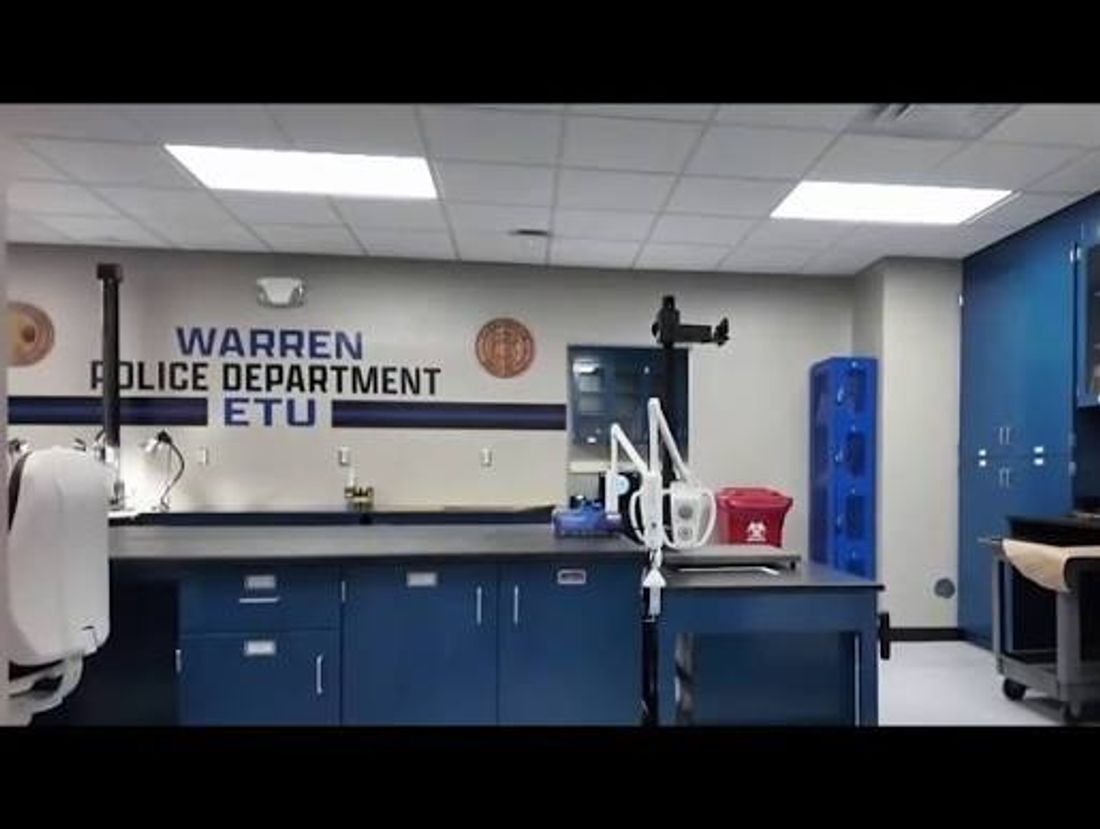
WARREN, Mich. — A newly renovated Warren Police Department evidence lab helped investigators process evidence from a recent bank robbery in less than 48 hours, the department says.
Police say a vehicle connected to the Nov. 3 robbery at a Huntington Bank near 10 Mile and Ryan was brought to the department’s evidence technician unit. Officers processed it and lifted several fingerprints.
“We were able to process it, lift a few prints from the vehicle and … get them in less than 48 hours,” said Ofc. Sevan Zayto, an evidence technician.
Police identified 56-year-old Roylee Buck of Harper Woods as a suspect using forensic and other evidence, then arrested him in Harper Woods, according to the department.
Buck was arraigned Nov. 6 in 37th District Court on one count of bank robbery as a habitual fourth offender. A judge set bond at $1 million cash or surety. Police said Buck was on parole for a federal bank robbery conviction at the time of his arrest.
Police allege the robber entered the bank, handed a teller a note demanding money while implying he had a weapon, then left with an undisclosed amount of cash.
The department recently unveiled a modernization of its 750-square-foot evidence laboratory, funded by a nearly $400,000 investment from the Downtown Development Authority. Police said the previous facility dated to the 1980s, and some forensic work had to be sent to regional or state labs.
Zayto said technicians photograph and process evidence and collect fingerprints. He called quick processing “very crucial” during investigations, citing a previous case in which a fingerprint lifted from a victim’s vehicle helped investigators make arrests that night.
Warren police say the lab is staffed around the clock by 12 officers trained in forensics, photography and latent fingerprint collection.
“We have 12 evidence techs, days and nights, so somebody’s always here,” Zayto said.
The department says Warren is the only law enforcement agency in Macomb County, and one of a small number in Michigan, with in-house latent fingerprint analysis. It works with the Oakland County Sheriff’s Office Forensic Lab, where a latent print expert can review prints and run them through the Automated Print Identification System.
A print does not have to be complete to be useful, Zayto said; technicians may be able to work with a partial print from a thumb, palm or pinky. They use different techniques to develop prints on surfaces including bottles, tools, weapons and paper.
Warren’s crime lab gets a high-tech makeover — and a fast test case