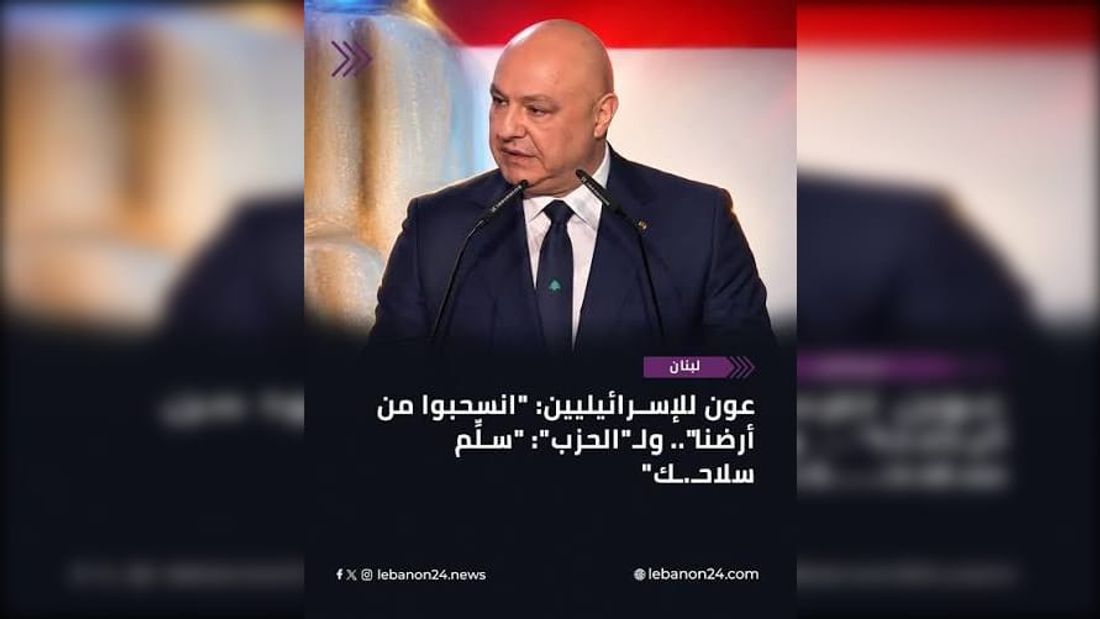
President of the Republic, General Joseph Aoun, delivered a speech at the Lebanese flag-raising ceremony at Nahr el-Kalb, marking the 83rd anniversary of Independence, in the presence of a large gathering of statesmen, politicians, and official bodies, in which he said:
"Lebanese men and women, every occasion has its symbolism, and every historical moment has its significance.
Today, we gather to raise the Lebanese flag at a critical moment in the history of our homeland, amid regional transformations and challenges. The symbolism of this occasion reminds us that the flag is not merely a piece of cloth; rather, it is a complete fabric—not a thread missing, not a stitch lacking. Just as the fabric of the homeland must be: not a grain of soil missing, and not a single citizen absent or excluded from its life.
From here, from Nahr el-Kalb—where tales of passing armies, ruling empires, and powers that thought they would remain forever are carved into the rock—we stand today to celebrate Lebanon's independence.
Yet what matters most in the timing of this celebration under our current circumstances is that despite everything that has befallen our independence, the clearest lesson of our history remains that the Lebanese have no alternative to their homeland, and this homeland has no alternative to a state that protects its independence and safeguards its sovereignty.
I did not come today to recount to you the history of independence. I came so that we may speak frankly about its present.
These rocks, which witnessed the passage of invaders and their departure, remind us of one truth: all those who passed through here departed, and Lebanon remained. Yet Lebanon's survival alone is not enough.
A homeland is not measured solely by its ability to endure, but by its ability to secure for its children a future worth staying for.
Here, on Independence Day, we must ask ourselves:
Have we achieved for the Lebanese the state they deserve?
The answer, in all candor, is: No, not yet.
We must not celebrate independence as though sovereignty were complete, while our land remains under occupation, our people have not all returned to their homes, and the decision of war and peace is not yet in the hands of the state alone.
We must not speak of restoring trust while citizens cannot recover their life savings, young people seek their future outside their homeland, and families do not know how to face tomorrow.
This is not the image of the independence we want. Acknowledging this reality is the beginning of the path to changing it.
Eighty-three years have passed since independence, and our independence has never once been complete. I do not say this out of pessimism, but out of honesty.
We treated independence as a certificate we earned once, rather than a responsibility we bear every day.
Over decades, we tried every alternative to the state, and we all paid the price.
We gambled on what is larger than Lebanon, so Lebanon shrank before our gambles. We sought strength from abroad and made enemies of one another. We accepted tutelages, so our decision remained in the hands of others. We were lenient in allowing decisions to be made outside the state, so occupation remained a pretext and war remained an inevitability.
We fought one another internally, and paid the price with our loved ones, our land, our wealth, and the future of our children.
Each time, the gambles changed, yet the price remained the same—and the Lebanese themselves paid it. And each time, every alternative to the state proved to be an illusion.
Let us say it without equivocation, having paid what we have paid:
There is no alternative to Lebanon’s independence, and no guarantee for Lebanon except its state.
Today, we stand before a fateful test.
Completing our independence today faces two fundamental, intertwined, closely linked, and fully interacting obstacles:
The Israeli occupation of parts of our land, and foreign interference in our affairs—specifically from certain influential parties within the Iranian regime, through weapons and decision-making outside the authority of the Lebanese state.
Two crises, I have said and I repeat, that are linked and inseparable. Each invites the other, uses it as a pretext, and provides it with a pretext at the very same time. In both cases, Lebanon is the one paying the price—especially the South and its people, who since 1969 have paid the price of successive wars, generation after generation.
Because we are aware of this reality—without sugarcoating or distortion—and because we know the extent of its danger to our people and our land, and consequently to the entire homeland, we have carried a rescue project based on simultaneity and parallelism in solving both problems together: no occupation whatsoever, definitively and forever; and no weapons outside the state that take orders from abroad and serve foreign agendas, whatever that foreign entity may be.
This is the essence of our national project. It is a stance that exposes us to campaigns from two opposing sides:
We face a campaign from forces in Israel calling for the continued occupation of our land because we told them publicly and directly: Withdraw from every inch of Lebanese territory, stop your aggressions, and return our prisoners.
You must realize that the people of the South are the children of this land; they are its soil and its air. They live only upon it, and it belongs only to them. They must return to it, and they will return. We will rebuild their homes. Know that from this moment until the end of time, no new reality will be imposed at the expense of their existence.
There will never be an extermination of our people. I say to those who believe that continued occupation and the use of force can provide security: occupation does not create security, and destruction does not create peace.
Withdraw now, and we are the sole, certain guarantee for our security, the stability of our borders, and our full sovereignty over all our land.
This is the only certain path to establishing security and stability along our internationally recognized southern borders, and developing a peaceful state of affairs there, as a mandatory gateway to any subsequent step toward a region enjoying a just and lasting peace.
Conversely, we face a similar campaign from the opposite side—from officials, concerned parties, and entities linked to Iranian interference in Lebanon's affairs—because we also confronted them with a clear and direct stance: the era of weapons outside the state is over. They fulfilled their duty in a previous era, with sacrifices and achievements, and then exhausted their people, their community, their nation, and their country in a subsequent stage, burdening them and burdening us with heavy losses once they openly came to serve non-Lebanese causes. You must acknowledge this, and you must hand over the weapons.
The Lebanese Army protects all of Lebanon and every Lebanese citizen. The state, through its constitution and laws, alone guarantees freedoms and rights for all citizens and all Lebanese communities. Let no one intimidate another.
No constitutional right will be shaken, no National Pact understanding will be reversed, and no freedom of any community will be infringed upon. We will protect one another and grow strong through our unity, and we will not seek strength from any foreign power against our partner in the homeland.
There shall be no persecution, no revenge, no vendetta, and no spite—nor obsessions with power, madness, fear, or intimidation. The state we want does not strip anyone of security; rather, it ends everyone's need to search for security outside of it: a just, capable state that pledges to protect everyone.
To those responsible for Iranian interference in Lebanon, I say with the same clarity: we respect the Iranian people and their civilization, and we want relations of friendship and mutual respect with Iran, as with all other countries.
However, friendship between states does not give one the right to interfere in the decisions of the other.
What you would not accept for your own country, do not ask Lebanon to accept for its country.
On this basis, we have rallied the support of the entire world for this perspective of ours: that saving Lebanon—which is necessary, vital, and fateful for its region and for the world—can only happen through a simultaneous and parallel resolution to both occupation and dysfunction.
As for us, we refuse for Lebanon to be held hostage to either of these two projects.
To those who gamble on the division of the Lebanese, I say to everyone at home and abroad: do not miscalculate.
In Lebanon today, there is a firm and clear Lebanese majority—and most importantly, one that transcends sects and regions—that wants the state and independence, and rejects occupation and hegemony. There is Arab and international support for the path of restoring Lebanon's sovereignty and stability, because Lebanon's security is a foundational part of the security of our surroundings and our world. Yet we do not want to replace one tutelage with another, nor one dependency with another. We want friends for Lebanon, not decision-makers on its behalf.
In a world that has witnessed successive wars, destroyed cities, and displaced peoples, it has become clear that military force may alter balances of power, but it cannot alone establish a lasting and just peace. War may impose a fait accompli, but it does not build a future.
Here I say that what I have defended since the beginning of my term, and what I continue to defend today, is not a stance imposed by Lebanon's weakness, but a choice whose necessity has been proven by facts. It is the choice of diplomacy. Diplomacy is not surrender, negotiation is not a concession of rights, and peace is not the opposite of dignity.
Strength is not measured only by the ability to wage wars, but also by the courage and wisdom to end them through diplomacy—especially when it is your own people who will pay the price. Yet diplomacy does not mean endless waiting, nor acceptance of the status quo. It is a path to reclaiming full rights, backed by the unity of the Lebanese stance, the capability of the state, and our Arab and international relations.
Lebanon will never be a bargaining chip in anyone's settlement. Lebanon is a homeland with a right to life, sovereignty, and peace.
To my people and my nation, I address you today with words stemming from the experience of one who spent two-thirds of his life as a soldier in the service of his homeland and people, and I say with full confidence: do not fear, do not despair, and do not grow weary. Ask yourselves, in a moment of any danger to your children and your homes, to whom do you look for protection? Whom do you trust to stand by your side without asking about your sect, your region, or your affiliation?
It is your Lebanese Army—the army of all Lebanon and all the Lebanese. This army that has never abandoned its duty despite all crises, and which bears the responsibility of protecting the homeland and defending its land and people.
The army is not the army of one faction against another, nor the army of one region against another; it is the army of the state, and its mission is to protect everyone. The guarantee of the security of the Lebanese does not lie in the multiplicity of weapons and decisions, but in one state, one army, and one legitimate authority bearing the responsibility of defending the homeland. The army is the legitimate military guarantee for protecting Lebanon, and the state is the framework that safeguards the security and rights of all its citizens.
Lebanese men and women,
Eighty-three years after independence, we are still fighting the same battle: the battle for Lebanon to be sovereign over its land and free in its decision-making. Yet history has taught us one thing: no occupation lasts, no tutelage lasts, and no force can confiscate the will of a people forever. We have proven that we are a people who do not perish.
The time has come to prove that we are capable of building a state with which the rights of its citizens never perish.
Long live Lebanon, sovereign over its land, free in its decision-making, united in its people and its state. Happy Independence Day while we remain here—free and strong."