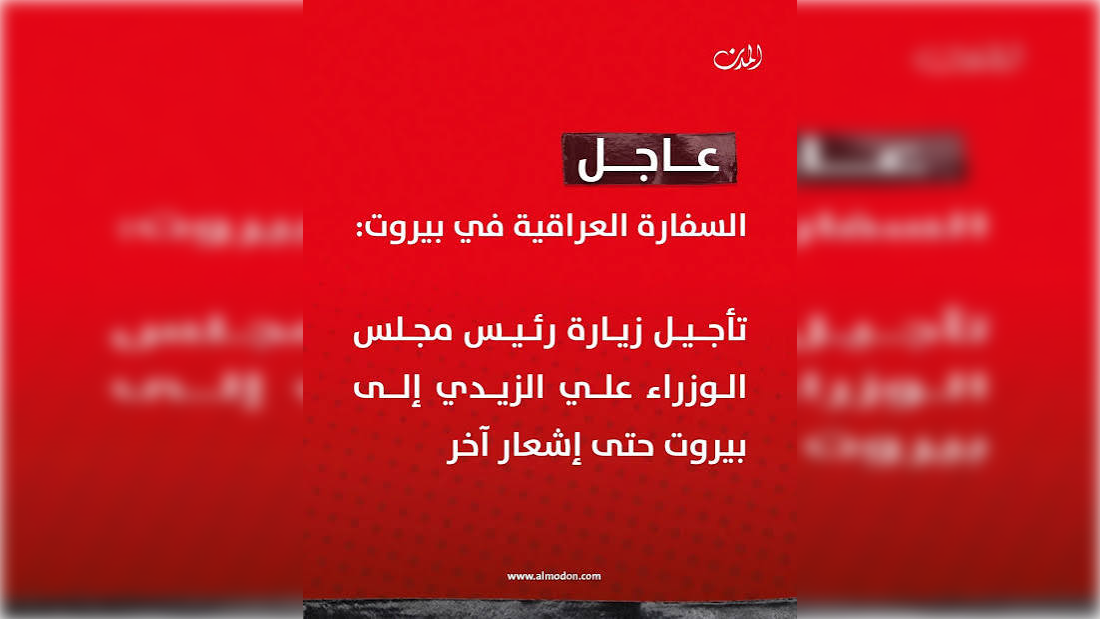
The Iraqi Embassy in Beirut announced on Tuesday evening that Iraqi Prime Minister Ali Al-Zaidi’s visit to Lebanon, which had been scheduled for Wednesday, has been postponed until further notice.
Information obtained by An-Nahar indicated that it was the Iraqi authorities who requested the postponement.
In this context, an Iraqi diplomatic source confirmed to An-Nahar that the postponement of Al-Zaidi’s visit to Beirut was due to Iraqi, rather than Lebanese, reasons.
The source explained that the decision was linked to developments in the security situation and the repercussions of the escalation in the Jurf Al-Sakhar area of Iraq. This comes amid the possibility of rapid developments in the coming hours that would require the Iraqi prime minister, in his capacity as commander-in-chief of the armed forces, to remain in the country to directly oversee any movements and take the necessary decisions.
Al-Zaidi’s visit to Lebanon was viewed as a significant extension of a diplomatic trend that has characterized recent days in Lebanon, marked by a notable increase in the number of foreign and Arab envoys and officials visiting the Lebanese capital.
The visit was also expected to go beyond the framework of economic cooperation to encompass a range of political, security, and financial issues. These include discussions on the killing of former Iraqi MP Ahmed Al-Alwani in Beirut, as well as strengthening security coordination between Lebanon, Iraq, and Syria, particularly in combating smuggling and organized crime and securing border controls.
The visit also carries a political and symbolic dimension, with Al-Zaidi expected to visit the tomb of former Hezb0llah Secretary-General Sayyed Hassan Nasrallah, in a notable gesture.
Economically the proposed revival of the Iraqi oil pipeline from Kirkuk to Tripoli through Syrian territory is expected to be a key issue. The project would provide Iraq with an additional outlet to the Mediterranean Sea and create opportunities to make use of Lebanon’s oil facilities.
The issue of Iraq’s outstanding financial dues owed by Lebanon under the fuel oil agreement will also be on the agenda. These are estimated at approximately $1.2 billion, with discussions expected on mechanisms for settling and rescheduling the payments.
There are also reports concerning Iraqi funds suspected of having been transferred to Lebanon and deposited in its banks.
The two sides are also expected to discuss activating the free trade agreement between the two countries and removing obstacles facing Lebanese exports to the Iraqi market. This would pave the way for expanding trade exchanges and transforming bilateral relations from temporary oil-related cooperation into a broader economic partnership.