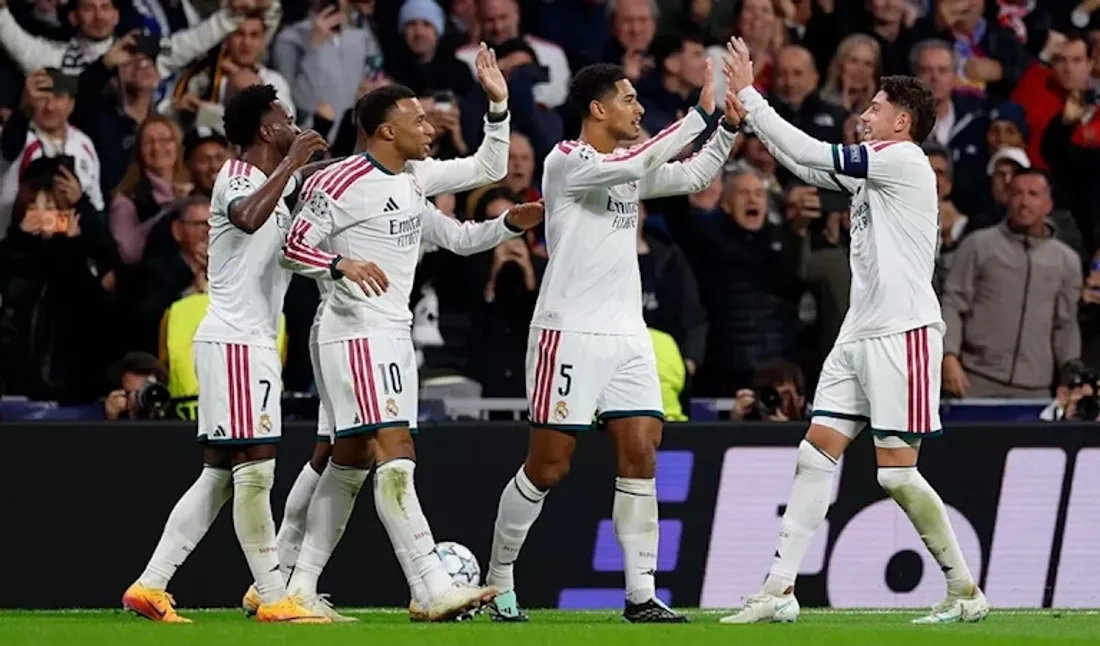
Spanish side Real Madrid secured a 5-1 victory, but the five goals against Dutch side PSV Eindhoven should not be viewed simply as an attacking turnaround after halftime. Rather, they reveal a contest between one team that closed off passing lanes but failed to protect them, and another that had the individual talent but lacked the connections between its players.
Madrid shifted from a struggling build-up and disconnected pressing to a system that attacked from closer positions and recovered possession before the opposition could reorganize. The tactical question is not how the team scored five goals, but how its shape changed until pressing itself became a source of scoring opportunities.
Mourinho started with a 4-3-3 formation, then shifted to a 4-2-3-1 during the build-up, with Tchouaméni and Bernardo Silva behind Güler, Diomande and Vinícius on the wings, and Mbappé through the middle. PSV, meanwhile, lined up in a 4-2-3-1 and shifted toward a 4-4-2 when pressing, as a player from the second line joined the center-forward. These formations were not merely numbers on paper; they determined how the press was directed and which players had to leave their positions to track the intended receiver.
Peter Bosz opted for player-oriented rather than space-oriented marking. Saibari followed Bernardo at the base of Madrid's build-up, while Geertruida stepped out from central defense to track Güler. This disrupted the connection between the player initiating the attack and the one receiving the ball between the lines. Madrid was therefore forced into slow sideways circulation or long balls before its players had moved forward to provide support.
Paradoxically, PSV's man-marking left spaces behind defenders who had stepped out of position. However, Madrid lacked the movement of the third man: the player who draws away his marker, the one who receives the ball, and the one who makes a run as soon as the passing lane opens. Mbappé's movement and that of the two wingers were disconnected from the timing of the pass, wasting the advantage offered by the open space.
Disjointed Lines
Defensively, Madrid did not press as a cohesive unit. The forwards advanced without the midfield and defense pushing up by the same distance, creating gaps in which PSV could receive the ball facing the goal. Van Bommel's attacks and Dest's movement exposed the danger of the channel between the full-back and center-back, while Tchouaméni's protection alone was insufficient to compensate for the distance between the lines.
The problem was not whether Madrid had four defenders or five midfielders, but the distance between the first player pressing the ball and those responsible for protecting the central areas.
At halftime, Mourinho abandoned his dedicated defensive holding midfielder, bringing on Bellingham for Tchouaméni, while Huijsen and Konaté replaced the two center-backs. The shape became closer to a 4-3-3, with Bernardo at the base of midfield and Güler and Bellingham ahead of him. When pressing, the team adopted a structure closer to 4-1-4-1, depending on which side of the pitch the ball was on.
It was a calculated risk: Madrid sacrificed a player specialized in providing fixed defensive protection in exchange for more passing angles and faster attempts to surround the opposition immediately after losing possession.
Bellingham gave the attack what it had previously lacked: well-timed arrivals into space rather than simply occupying it. When Güler dropped back to receive the ball, the English midfielder moved behind the opposition midfielder. If a defender followed him, a channel opened for Mbappé. This left PSV's marking system with two unfavorable options: follow the receiver and leave space behind, or hold its position and allow the ball carrier to advance. This was how the third-man movement, missing before halftime, finally emerged.
Transformation Without the Ball
In the equalizer sequence, Vinícius pinned the defense to the left before the ball was switched toward Diomande. Güler then laid it off with his heel, allowing Valverde to arrive from deep. The advantage was created not by the touch alone, but by the full-back's arrival into an unmarked space.
The deeper transformation, however, came without the ball, as Huijsen and Konaté pushed the defensive line higher behind the press and Madrid's units moved closer together. PSV no longer had time to turn or play the next pass. The forwards' pressing became linked to the midfield closing off nearby options, while the defense stepped forward to engage the ball rather than retreating in front of it.
As a result, winning possession in PSV's half became the starting point for direct attacks. Güler's recovery of the ball before passing it to Mbappé is a clear example of how regaining possession had become part of creating a goal rather than a separate defensive task.
This arrangement was not sustainable without a cost. Mourinho brought on Camavinga for Güler to restore some balance in midfield. The substitution revealed the limits of the gamble: the forward movement of Bernardo, Güler, and Bellingham gave Madrid the ability to suffocate the opposition, but it also left dangerous spaces if the first wave of pressure was bypassed.
The value of the victory, therefore, lies not in the five goals but in a more precise tactical lesson: formation determines the starting positions, but synchronization between passing, movement, pressing, and defensive protection is what turns a diagram on paper into a dominant team.