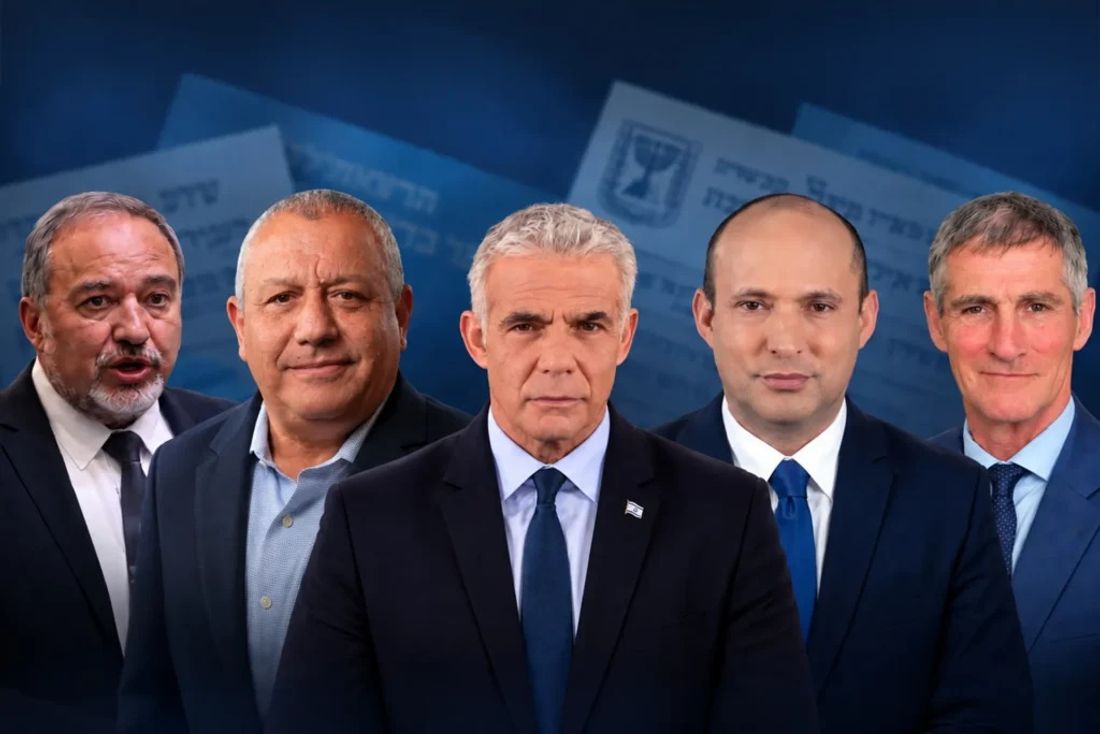
The process of forming a new Israeli government has entered a critical stage as the deadline granted to Yashar Party leader Gadi Eisenkot approaches on December 6. Disagreements persist among his supporters over how to secure a parliamentary majority for any governing coalition.
The only significant development in this regard was the announcement by Eisenkot’s party of a coalition agreement with Yisrael Beiteinu, led by Avigdor Lieberman. This is the first official agreement of its kind since the elections. Reports indicate that Lieberman is seeking key ministerial portfolios, including Defense, Justice, and Immigration and Absorption.
However, this rapprochement has not come without repercussions within the anti-Netanyahu camp. The Democrats Party, led by Yair Golan, suspended its talks with Eisenkot in protest over his willingness to negotiate with Likud and the ultra-Orthodox parties, rather than relying on support from the Arab parties.
Eisenkot faces three possible paths in his attempt to form a government:
- An alliance with the ultra-Orthodox parties: Contacts are underway with United Torah Judaism, which has distanced itself from Netanyahu, amid reports of understandings aimed at freezing disagreements over religion-and-state issues. However, the success of this option requires resolving disputes over mandatory military service and exemptions granted to students at religious seminaries.
- Forming a national unity government: Contacts between Eisenkot’s party and Likud are continuing over the possibility of forming a unity government. However, this option faces opposition from the anti-Netanyahu camp, which insists that he must leave the premiership.
- A minority government backed by the Arab parties: This option envisages forming a government without a stable majority within the coalition, but with support from the Arab parties from outside the government. Lieberman and some of Eisenkot’s allies reject this approach, while Yair Golan is pushing for it.
Meanwhile, Benjamin Netanyahu is not standing outside the negotiations. Rather, he is seeking to prevent the breakup of his political camp, particularly by winning over the ultra-Orthodox parties that formed a key part of his previous coalition. Israeli media reports say Netanyahu has intensified his contacts with United Torah Judaism leaders in an effort to prevent the party from joining Eisenkot’s camp.
In contrast, Israeli media outlets have quoted people close to Netanyahu as saying that he has become increasingly concerned about the possibility of his rival succeeding in forming a government, amid the growing rapprochement between Eisenkot and Lieberman and progress in talks with some ultra-Orthodox factions.
Prospects for Forming the Government
Can Eisenkot Form a Government Before the Deadline Expires?
Information published as of the morning of November 26 indicates that Eisenkot is seeking to conclude negotiations and inform the president that he has formed a government next week, before the original deadline expires.
Media reports have quoted political sources as saying that his plan is to complete negotiations with Likud and the ultra-Orthodox parties. If that proves impossible, he would move to the option of a government relying on support from the Arab parties from outside the coalition, without waiting for an extension of the deadline.
However, there is an important distinction between announcing a coalition agreement and actually forming a government. The government, its program, and the distribution of ministerial portfolios must be presented to the Knesset and receive the confidence of its members in accordance with the established constitutional procedures.
Accordingly, forming a government before December 6 is a serious possibility given the accelerating negotiations, but it remains contingent on overcoming disagreements over political partners and securing a parliamentary majority.
If Eisenkot fails to form a government within the allotted period, the president may grant him an extension of up to two weeks. If he still fails, the mandate to form a government could pass to another candidate, with Netanyahu among the leading possibilities.
If all candidates fail to form a government, Israel could head toward early parliamentary elections sometime next year.
The significance of the Israeli government crisis extends beyond the rivalry between Netanyahu and Eisenkot; it also concerns the political direction that will shape Israeli policy in the coming period.