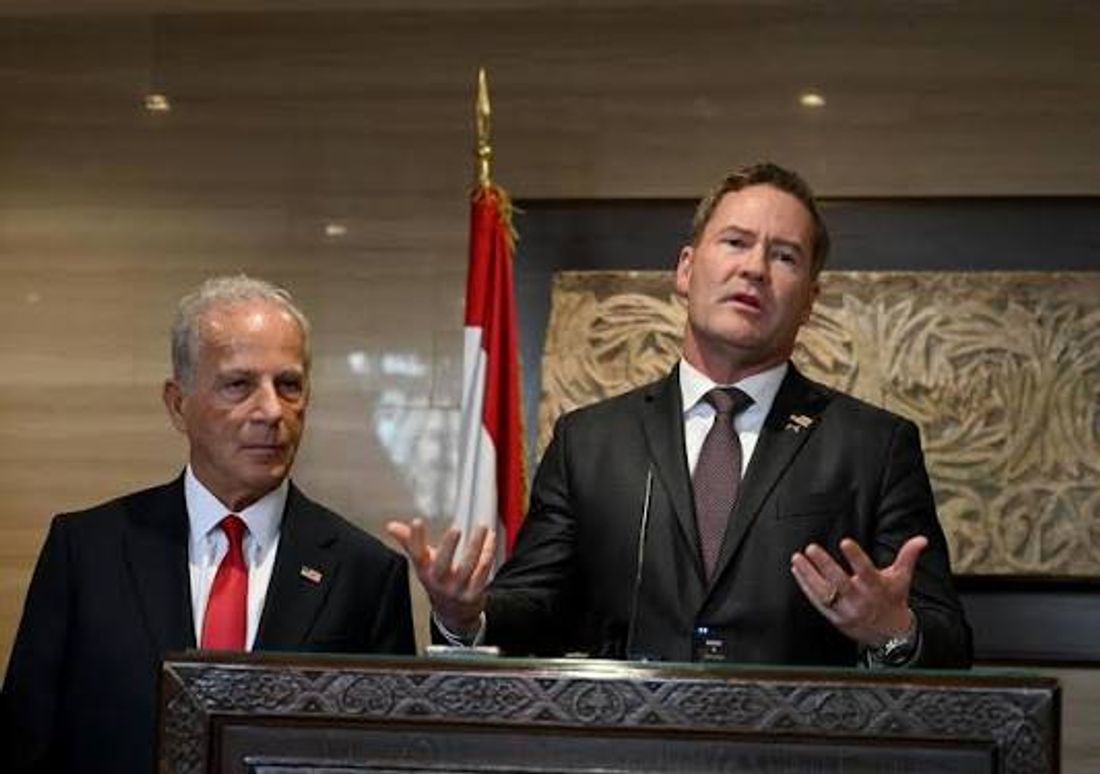
Lebanese newspapers today continued to follow the repercussions of the visit by US Ambassador to the United Nations Mike Waltz.
According to information obtained by *An-Nahar*, the US proposal for the period following UNIFIL’s withdrawal includes deploying a multinational force of no more than 100 personnel, with its geographical area of operations expanded to include the region north of the Litani River. The force would be established under a UN resolution that takes into account the Tripartite Framework Agreement.
Waltz reportedly informed President Joseph Aoun that work was underway at the Security Council to draft a resolution based on Resolution 1701, with amendments and updates, incorporating elements of the Tripartite Framework Agreement.
Accordingly, the United States and France are coordinating on a formula that would maintain a commitment to Resolution 1701 while incorporating the Framework Agreement into the mandate of the new force.
However, an official source told the Central News Agency that the Presidency had not received any such proposal and that no new information on the matter had emerged that day.
Asharq Al-Awsat quoted sources familiar with the atmosphere surrounding Waltz’s meetings with the Lebanese presidents as saying that he had agreed with Lebanon’s insistence on Resolution 1701 and the need to implement it, and on the requirement that any successor force receive a United Nations mandate.
The sources revealed that Aoun and Prime Minister Nawaf Salam had not objected to Waltz’s desire to incorporate the Framework Agreement into the resolution, unlike Parliament Speaker Nabih Berri, who opposed the proposal.
The newspaper reported that Waltz did not raise during his meetings, contrary to reports circulating before his arrival in Beirut, the possibility of relying on a civilian monitoring force or adopting a model similar to the one operating in Egypt’s Sinai Peninsula.
It noted that the three Lebanese presidents insisted on the need to agree on an international mechanism to verify the Lebanese Army’s deployment in areas from which Israeli forces withdraw, while also ensuring that those areas are free of Hezb0llah weapons and fighters.
The sources stressed that, from their perspective, agreement among the presidents on an international monitoring mechanism would prevent any calls for direct coordination between Lebanon and Israel without an international monitoring team in place. Such a team would oversee the implementation of any agreed arrangements and intervene to address any emerging disputes between the two sides.
They said Waltz had initially shown little enthusiasm for the presidents’ insistence on implementing Resolution 1701, arguing that Lebanon’s approval of the Framework Agreement meant it was entering a new political and security phase. However, he subsequently showed willingness to accommodate their position, although he proposed incorporating the Framework Agreement into the resolution.
This would mean that, if the Security Council approved merging the two, the Framework Agreement would become internationalized rather than remaining limited to its three signatories.
The sources also revealed that Waltz spoke positively about France’s position and the possibility of involving Paris in the successor force to UNIFIL, given that merging Resolution 1701 with the Framework Agreement would require international backing through Security Council approval.
Waltz is expected to brief US Secretary of State Marco Rubio on the outcome of his meetings in Beirut, enabling him to take the necessary steps, beginning with contacting his counterparts from the Security Council member states, particularly the permanent members, to secure approval of the amendment to Resolution 1701 through the incorporation of the Framework Agreement and prevent them from exercising their veto power during the vote.
Meanwhile, *Al-Diyar* quoted informed diplomatic sources as saying that Mike Waltz’s visit to Beirut had revealed that Washington wanted to establish “Resolution 1701 plus” as the gateway to any new arrangements, rather than as the end of the discussion surrounding them.
The sources considered that the understanding reached with Lebanon remained limited to broad principles. They added that the talks had revealed a fundamental disagreement between Washington and Beirut over the content of the forthcoming resolution, despite differences that emerged among the Lebanese presidents themselves and were discussed by Waltz and US Ambassador to Lebanon Michel Issa.
Lebanon, the sources said, is insisting on a clear UN framework and on synchronizing Israel’s withdrawal with the extension of state authority. Washington, by contrast, is pressing to introduce broader implementation arrangements, primarily based on the Framework Agreement, into any UN proposal.
It was agreed that the French would take the lead in drafting the proposal at the Security Council and in communicating with Russia and China on the matter.
The diplomatic sources pointed out that the disagreements were not merely about wording, but also concerned the inclusion of the Framework Agreement and the obligations and mechanisms it could entail.
Ain al-Tineh, Berri’s headquarters, stressed that Resolution 1701 addresses the border, Israel’s withdrawal, and the mandate of international forces, whereas the Framework Agreement involves broader arrangements, including joint coordination committees between Lebanon and Israel.
It considers that combining the two frameworks raises political and legal contradictions, particularly since the Framework Agreement has neither been approved by the Council of Ministers nor discussed in Parliament.
The sources concluded that the next battle would be decided by the precise wording of the resolution: who monitors, who is bound by the arrangements, when the withdrawal is implemented, and what reciprocal guarantees are provided.